
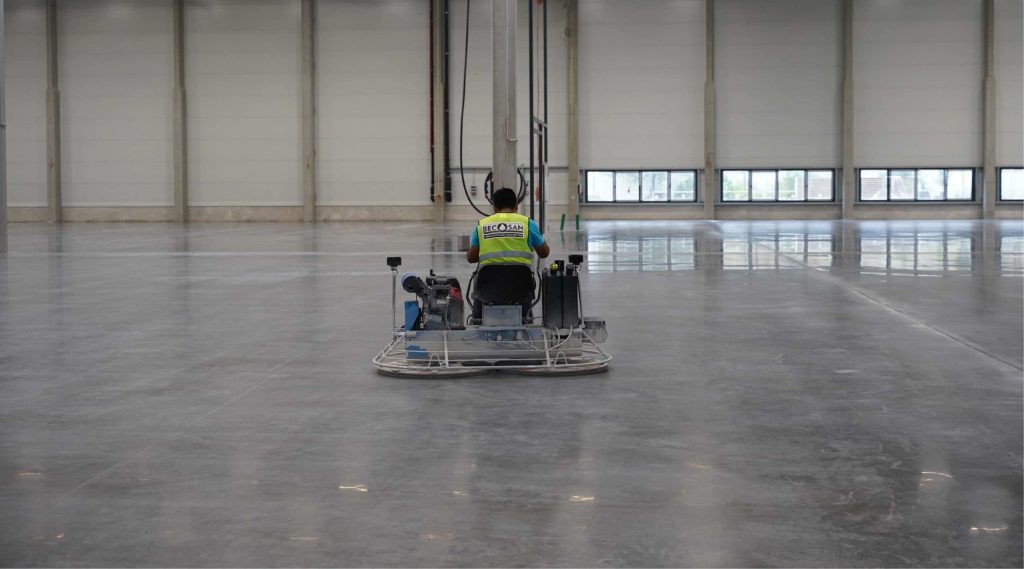
Today, polished concrete is widely used in warehouses, factories, showrooms, shopping malls, offices, hotels, retail spaces, restaurants, educational institutions, and other commercial environments. Its durability, clean appearance, long service life, and relatively low maintenance requirements make it an attractive flooring option for many projects.
What Is Polished Concrete?
Polished concrete is a concrete floor that has been mechanically ground, refined, and polished using specialized diamond grinding equipment. The process gradually removes surface imperfections and creates a dense, smooth, and visually appealing finish.
Depending on the desired appearance and performance, the concrete can be polished to different levels of gloss, from a subtle matte finish to a highly reflective surface. The process may also expose the fine aggregate, sand, or larger stones within the concrete, creating different decorative effects.
Unlike epoxy flooring, polished concrete does not require a thick resin coating to create its finished appearance. Instead, the concrete itself becomes the finished flooring surface.
How Is Polished Concrete Applied?
Professional polished concrete installation generally involves several stages. Proper surface preparation is essential because the final appearance and durability depend heavily on the condition of the concrete slab.
1. Surface Inspection
Before starting the work, the concrete floor is inspected for cracks, damaged areas, unevenness, contamination, moisture problems, and other defects. Any significant structural or surface problems should be addressed before polishing.
2. Diamond Grinding
The first major stage is mechanical grinding. Industrial floor grinders equipped with diamond tools are used to remove laitance, stains, minor surface imperfections, and unwanted materials.
Several grinding passes may be required depending on the condition of the floor and the desired level of aggregate exposure.
3. Crack and Joint Repair
Visible cracks, holes, and damaged sections are repaired using suitable repair materials. Construction joints and control joints may also require treatment depending on the project requirements.
4. Densification
A concrete densifier or hardener may be applied to the prepared concrete surface. This treatment reacts with components within the concrete and helps increase surface hardness and reduce dusting.
Densification is particularly important for industrial and commercial floors that experience heavy foot traffic, forklifts, machinery, or other forms of abrasion.
5. Fine Grinding and Honing
After densification, finer diamond abrasives are used to progressively refine the surface. Each stage reduces visible scratches left by the previous grinding stage.
The number of stages depends on the required finish and specification.
6. Polishing
The floor is polished using progressively finer diamond tools until the required appearance is achieved. A project can have a low-sheen, satin, or high-gloss finish depending on the customer’s requirements.
7. Final Protection
A suitable stain guard or protective treatment may be applied to improve resistance to staining and make routine cleaning easier. The specific protection system should be selected according to the environment and expected chemical exposure.
Advantages of Polished Concrete
One of the biggest advantages of polished concrete is durability. Properly prepared and maintained polished concrete can withstand heavy traffic and demanding commercial environments.
Another important advantage is low maintenance. The smooth surface does not have grout lines like tiled flooring, which makes routine cleaning easier. Regular sweeping, dust removal, and appropriate mopping can help maintain its appearance.
Polished concrete also offers a modern architectural appearance. Depending on the aggregate exposure and polishing level, designers can achieve anything from a simple industrial appearance to a sophisticated decorative finish.
The flooring can also help improve light distribution inside a building. A polished surface reflects more available light than a rough concrete surface, which can contribute to a brighter interior environment.
Polished Concrete vs. Epoxy Flooring
Polished concrete and epoxy flooring are both widely used in commercial and industrial environments, but they work differently.
Polished concrete uses the existing concrete as the finished surface, while epoxy flooring creates a resin-based coating over the prepared substrate.
Epoxy can provide specific chemical resistance, color options, decorative effects, seamless finishes, and specialized performance characteristics. Polished concrete, on the other hand, provides a natural concrete appearance and can be particularly suitable where mechanical durability and low maintenance are important.
The appropriate system depends on factors such as traffic, chemical exposure, moisture, required appearance, existing concrete condition, hygiene requirements, and project budget.
Applications of Polished Concrete
Polished concrete is suitable for many commercial and industrial applications, including:
- Warehouses
- Manufacturing facilities
- Retail stores
- Shopping malls
- Showrooms
- Offices
- Restaurants and cafés
- Hotels
- Schools and universities
- Garment and textile facilities
- Automobile facilities
- Commercial corridors
- Large public spaces
For industrial facilities, the concrete substrate should be carefully evaluated before selecting polishing as the final flooring system.
Maintenance of Polished Concrete
One of the major benefits of polished concrete is its straightforward maintenance requirements. Dust and loose particles should be removed regularly because abrasive dirt can gradually affect the surface.
Cleaning should be performed using suitable neutral cleaning products and appropriate equipment. Harsh chemicals should not be used unless they are confirmed to be compatible with the floor system.
Spills should be cleaned promptly, particularly in areas where oils, dyes, food products, or other staining materials are present.
Heavy industrial environments may require periodic professional maintenance to preserve the desired appearance and surface performance.
Factors Affecting Polished Concrete Cost
The cost of polished concrete varies considerably from one project to another. Important factors include the existing concrete condition, total floor area, required level of aggregate exposure, number of grinding and polishing stages, repair requirements, desired gloss level, densifier and protective products, site accessibility, and labor requirements.
A large, open floor with good-quality concrete may be comparatively straightforward to polish, while an old or damaged floor may require extensive preparation and repair.
Therefore, a proper site inspection is recommended before preparing a final quotation.
Is Polished Concrete Suitable for Industrial Flooring?
Polished concrete can be an effective industrial flooring solution when the existing concrete slab has suitable strength, condition, and characteristics for polishing.
However, not every industrial environment should automatically use polished concrete. Facilities exposed to aggressive chemicals, acids, oils, continuous wet conditions, or specific hygiene requirements may require a specialized coating or resin flooring system instead.
The correct flooring solution should therefore be selected based on the actual operating conditions rather than appearance alone.
Conclusion
Polished concrete offers a combination of durability, modern appearance, easy maintenance, and long-term practicality. Through professional grinding, densification, honing, and polishing, an ordinary concrete slab can be transformed into an attractive finished floor suitable for many commercial and industrial applications.
For factories, warehouses, showrooms, offices, retail spaces, and other high-traffic environments, polished concrete can provide a clean and durable flooring surface without requiring traditional tile or thick coating systems.